





The basic concept of heavy calcium carbonate
Heavy calcium carbonate is a common inorganic compound with the chemical formula CaCO₃. It is one of the most widely distributed minerals in nature. It is composed of three elements: calcium, carbon, and oxygen. In nature, it exists in various forms, such as calcite, aragonite, and chalk. The main difference between heavy calcium carbonate and light calcium carbonate lies in the production process and physical properties. The former is obtained by directly crushing natural minerals through mechanical methods, while the latter is produced through chemical reaction precipitation.
From an external perspective, heavy calcium carbonate usually appears as white powder or particles, odorless and tasteless. It is insoluble in water but soluble in acids. Its density is generally between 2.7 and 2.9 g/cm³, and its Mohs hardness is 3, making it a relatively soft mineral. In nature, heavy calcium carbonate constitutes the main component of many rocks, such as limestone and marble, which are formed through geological processes over millions of years.
2. Production process of heavy calcium carbonate
The production process of heavy calcium carbonate is relatively simple and mainly consists of the following steps:
1. Raw material selection: High-purity limestone or marble is chosen as the raw material. The calcium carbonate content in these materials is usually above 95%, with low impurity content.
2. Crushing process: Use jaw crushers or hammer crushers to initially break the large chunks of ore into smaller particles, making it easier for subsequent processing.
3. Grinding process: The crushed particles are further ground into fine powder using equipment such as Raymond mill, ball mill or vertical mill. This step allows for the control of the particle size distribution of the final product.
4. Grading process: Utilize an air classification machine or a vibrating screen to separate the ground powder into different particle sizes, thereby obtaining products that meet the requirements of various applications.
5. Surface treatment (optional): According to customer requirements, some products will undergo surface modification treatment, such as being coated with treatment agents like stearic acid, to improve their dispersibility and compatibility in polymers.
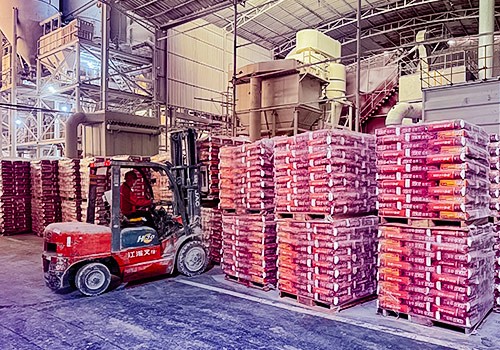
6. Packaging and Storage: Finally, the finished products should be packaged according to the specifications and stored in a dry environment to prevent moisture absorption and clumping.
The entire production process does not involve complex chemical reactions. It mainly involves physical processing, so the energy consumption is relatively low and the environmental pollution is minimal.
3. Main Characteristics of Heavy Calcium Carbonate
Heavy calcium carbonate possesses a series of unique physical and chemical properties, which enable it to be widely used in various fields:
1. Physical properties:
- White powder, with excellent whiteness and brightness
The particle size range is wide, ranging from a few micrometers to several tens of micrometers.
- Relatively heavy, with high bulk density
- Good thermal stability; it begins to decompose at approximately 825℃.
2. Chemical Properties:
It is chemically stable at room temperature.
It will react with strong acids and release carbon dioxide.
It is almost insoluble in water, but it can make the water slightly alkaline.
- Non-toxic and harmless, with high safety.
3. Optical Performance:
The refractive index is 1.49 - 1.66.
- Possessing excellent light scattering ability
- Can enhance the opacity and whiteness of the product
4. Rheological Properties:
Can improve the rheological properties of the system
At an appropriate addition amount, it can increase the viscosity of the system.
Sensitive to shear force and exhibiting shear thinning characteristics
These characteristics make heavy calcium carbonate an important functional filler in many industrial products.
4. Application fields of heavy calcium carbonate
Due to its excellent performance and reasonable price, heavy calcium carbonate is widely used in the following industries:
1. Plastics Industry:
- As an incremental filler, it helps reduce production costs.
Improve the rigidity, dimensional stability and surface gloss of plastic products
Used for PVC pipes, profiles, films, injection molded products, etc.
2. Paper Industry:
Used as a filler for paper production, it enhances the whiteness and opacity of the paper.
- As a coating pigment, it improves the smoothness of the paper surface and the printing properties.
It can partially replace the expensive titanium dioxide, thereby reducing costs.
3. Paint Industry:
- As a pigment, it enhances the covering power and durability of the coating.
Adjust the glossiness and leveling property of the coating.
- For interior and exterior wall coatings, industrial coatings, etc.
4. Rubber Industry:
- As reinforcing fillers, they enhance the mechanical properties of rubber products.
Improve processing performance and reduce production costs
- For use in tires, rubber hoses, rubber bands, etc. products
5. Building Materials Industry:
One of the raw materials for producing cement
- For use in artificial stone, sealant, putty powder and other building materials
- As a filler for asphalt mixtures
6. Other Applications:
Food-grade products are used as nutritional fortifiers and anti-caking agents.
-Medical-grade products are used as excipients for tablets
Feed-grade products as calcium source supplements
- In the field of environmental protection, it is used for wastewater treatment and sulfur dioxide removal from flue gas.
5. Current Market Situation and Development Trends of Heavy Calcium Carbonate
Heavy calcium carbonate, as a basic industrial raw material, has a market demand closely related to economic development. In recent years, with the continuous development of downstream industries, the consumption of heavy calcium carbonate has maintained a steady growth. From a regional perspective, production bases are mostly located near raw material sources to reduce transportation costs. The product specifications have also become increasingly diverse, ranging from ordinary powder to ultra-fine powder, surface-modified products, etc., to meet the needs of different fields.
The future of the heavy calcium carbonate industry is likely to exhibit the following trends:
Product refinement: Develop products with finer particle size and narrower particle size distribution to meet the demands of high-end applications.
2. Functionalization development: Through surface modification and other techniques, special functions are imparted to the products, such as strengthening, toughening, and UV resistance.
3. Green Production: Optimize production processes, reduce energy consumption, minimize dust emissions, and achieve clean production.
4. Application Expansion: Seek application opportunities in emerging fields such as new materials and new energy, such as lithium battery separators and degradable materials.
5. Intelligent Manufacturing: Introduce automated control systems to enhance production stability and product consistency.
With technological advancements and industrial upgrading, this traditional product, heavy calcium carbonate, will continue to play a significant role and provide cost-effective solutions for various industries.